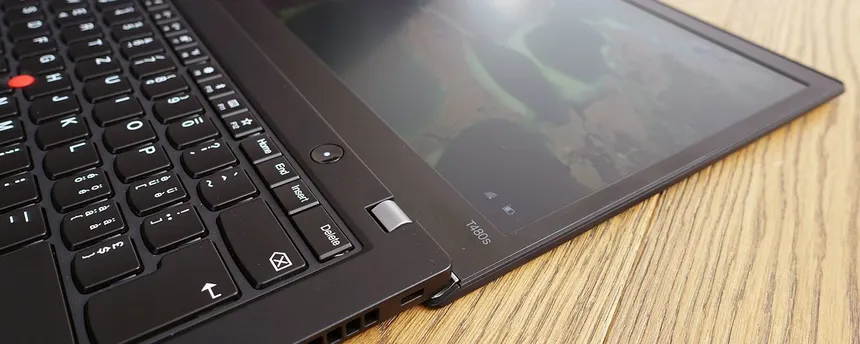
Lenovo ThinkPad T480s (2018) is a durable, lightweight business laptop designed for portability and performance, featuring an 8th Gen Intel Core processor (i5-8250U or i7-8550U), up to 16GB of RAM, and a 256GB NVMe SSD. It offers up to 15.6 hours of battery life, a 14-inch FHD (1920x1080) IPS display, and a ThinkShutter camera cover for privacy. The laptop includes Thunderbolt 3, HDMI, USB-C, USB 3.0, and an Ethernet port, making it highly versatile for business use.
It only uses nmve, and yes, you do have to use a hacked Windows7, but unlike more modern computers, it at least talks the language Windows7 talks, so while with more modern ones there's much more hacking/modifications and it still might not boot, this one is minimal and everything should just work. It can be LIBREBOOTED, but this is a hardware thing (hardware tool like a CH341A programmer (with a 3.3V mod) and a SOIC-8 clip.).
When you look at the raw numbers, the i7 seems faster, but in a thin laptop like the T480s, the "real-world" benchmark is often a tie. Because both chips have the same 4 cores and 8 threads, the cooling system becomes the bottleneck, not the silicon.
i5 then i7 PassMark (Multi-Thread) ~6,105 ~6,194 ~1.5% PassMark (Single-Thread) 1,988 2,102 ~5% L3 Cache 6MB 8MB +2MB Max Turbo Frequency 3.6 GHz 4.2 GHz +600 MHz
For a hacked Windows 7 and DSP56300 VSTs—the i5 version of the T480s is arguably better than the i7. Identical core counts, plus...
The T480s is a slim laptop. The i7-8650U generates a lot of heat. Because the cooling system is identical for both models, the i7 often hits its thermal limit and throttles (slows down) within minutes of heavy use. The i5-8350U runs cooler and can maintain its "Turbo" speed for much longer. In real-world music production (where you have sustained CPU loads from VSTs), an i5 that stays at 3.0GHz is better than an i7 that spikes to 4.0GHz and then crashes down to 1.8GHz because it got too hot.
The Throttling Trap: Under a sustained load (like running your DSP56300 VSTs in Ableton), both CPUs will eventually drop their speed to around 2.6 GHz – 2.9 GHz to keep from melting. The i7 might start faster, but it hits the "heat wall" sooner and throttles harder. Audio Latency: For music production, stability is more important than "peak speed." The i5 generates less heat, meaning the cooling fan doesn't have to ramp up and down as aggressively, which can sometimes cause tiny voltage spikes or "DPC Latency" pops in your audio. The Cache Benefit: The i7’s extra 2MB of L3 cache can help with complex sample-based instruments, but the DSP56300 emulators are purely mathematical/algorithmic. They care more about steady clock speed than cache size.
Key highlights:
- Processor: Intel Core i5-8250U or i7-8550U (quad-core, up to 4.0 GHz turbo).
- Storage: 256GB NVMe SSD (upgradable).
- Display: 14" FHD IPS (1920x1080), anti-glare, 250 nits brightness.
- Ports: Thunderbolt 3, HDMI, USB-C, USB 3.0, Ethernet, SD card reader, headphone/mic jack.
- Security: ThinkShutter, fingerprint reader, security chip, Kensington lock slot.
- Operating System: Windows 10 Pro or Windows 11 Pro (refurbished models).
- Some come as touch screen but not most
WEIGHT
- ThinkPad T480s ~1.32 kg ~2.9 lbs Slim, modern slab.
- ThinkPad T480 (Small Battery) ~1.63 kg ~3.6 lbs Boxy, traditional build.
RAM, the "Official" vs. "Real" Max. Lenovo says: The max is 20GB or 24GB. (This is because when the laptop was released, the largest single RAM stick you could buy was 16GB). The Reality: The max is 40GB. This is for i5 and i7 both. You can successfully install a 32GB stick in the expansion slot, and it will work perfectly. The non slim T480 has two non soldered slots so can hold up to 64GB.
Audio is about Capacity: In music production, the biggest performance killer is running out of RAM and having your computer use the "Page File" (the SSD) as emergency memory. Even "slow" Single-Channel RAM is thousands of times faster than the fastest SSD.
Modern Intel-based laptops like the T480s use a technology called Intel Flex Mode, so you can have non paired RAM (the soldered 8gb plus expansion 32gb). The Dual-Channel Zone (First 16GB): The 8GB of soldered RAM pairs up with the first 8GB of your 32GB stick. This creates a 16GB "high-speed" block that runs in Dual-Channel Mode. The Single-Channel Zone (Remaining 24GB): The leftover 24GB on your 32GB stick will run in Single-Channel Mode.
POSSIBLE RAM CONFIGURATIONS IN THE T480s
- Scenario A: Your T480s has 4GB soldered + 16GB stick = 20GB Total (most come with 8 but some have 4)
- Scenario B: Your T480s has 8GB soldered + 32GB stick = 40GB Total
RAM TYPE
- Type DDR4 SODIMM (260-pin)
- Speed 2400MHz (You can use 3200MHz; it will just slow down to 2400MHz


Comments: 0